

The 10-Second Ritual That Saves 15 Minutes Per Interruption
A tiny capture habit that lets you walk away mid-thought and come back without losing a single sentence.

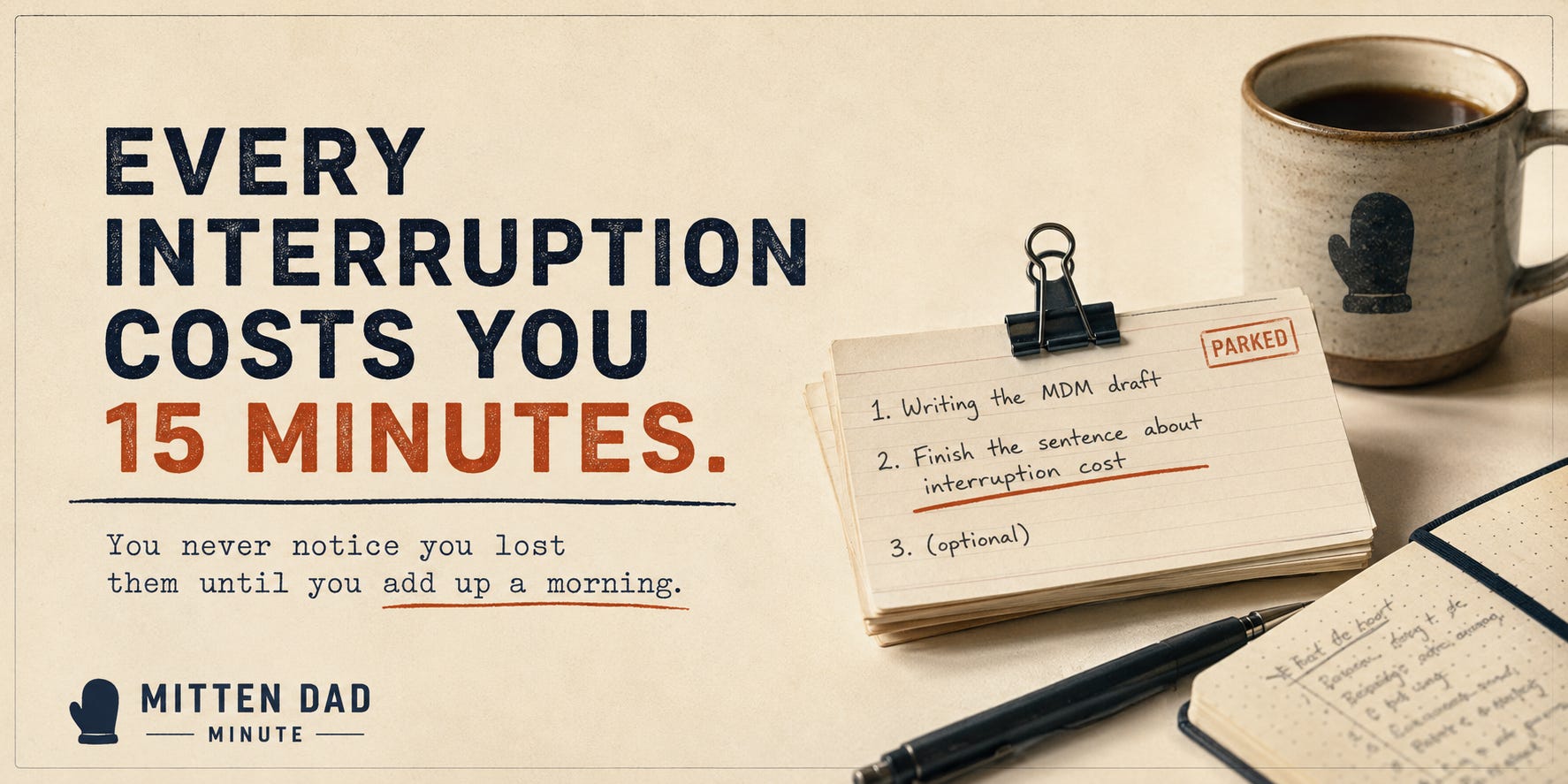
Every interruption costs you 15 minutes. You never notice you lost them until you add up a morning.
It was a Thursday morning, and I was two sentences into a paragraph I actually liked. Then: “Dad, can I have a snack?” I said yes, got up, got the snack, sat back down. Stared at the cursor. The sentence was gone. Not the topic, not the general idea. The actual sentence, the one I’d already half-written in my head, evaporated the second I stood up.
Twenty minutes later it happened again. A Slack message this time. Then the dog needed out. Then a delivery at the door.
By lunch I’d been interrupted six times and made real progress on nothing. Not because the interruptions were long. Each one took thirty seconds. But getting back to where I’d been took ten times that, every single time.
For years I assumed this was a discipline problem. Get better at holding the thread. Concentrate harder. Write faster before the next interruption lands.
I think you know where this is going. That instinct is backwards. You can’t out-focus a four-year-old, and you shouldn’t want to.
Park it.
Park it
I tried the notebook. I tried sticky notes on the monitor. I tried voice memos to myself, which mostly captured me sounding confused, or stammering. All of it failed for the same reason: too much friction in the exact moment I had none to spare.
You cannot open an app, find the right note, and write a clear paragraph in the three seconds between “Dad?” and actually turning around.
Whatever the system was, it needed to survive being used one-handed, mid-sentence, with a four-year-old already three words into her next request.
Researcher Gloria Mark, who’s spent years studying attention at UC Irvine, has tracked this for over a decade: once you’re pulled off a task, it takes an average of 23 minutes to fully re-engage with it. Not because the task got harder. Because your brain has to rebuild the entire mental scaffolding it was standing on.
You can’t stop a four-year-old from needing a snack. But you can stop that snack from costing you half an hour of writing.
So I built a system around a single constraint: it has to be faster than the interruption itself. I called it the Park-and-Return Method, and eventually I built it into an actual app because I couldn’t find one that did just this.
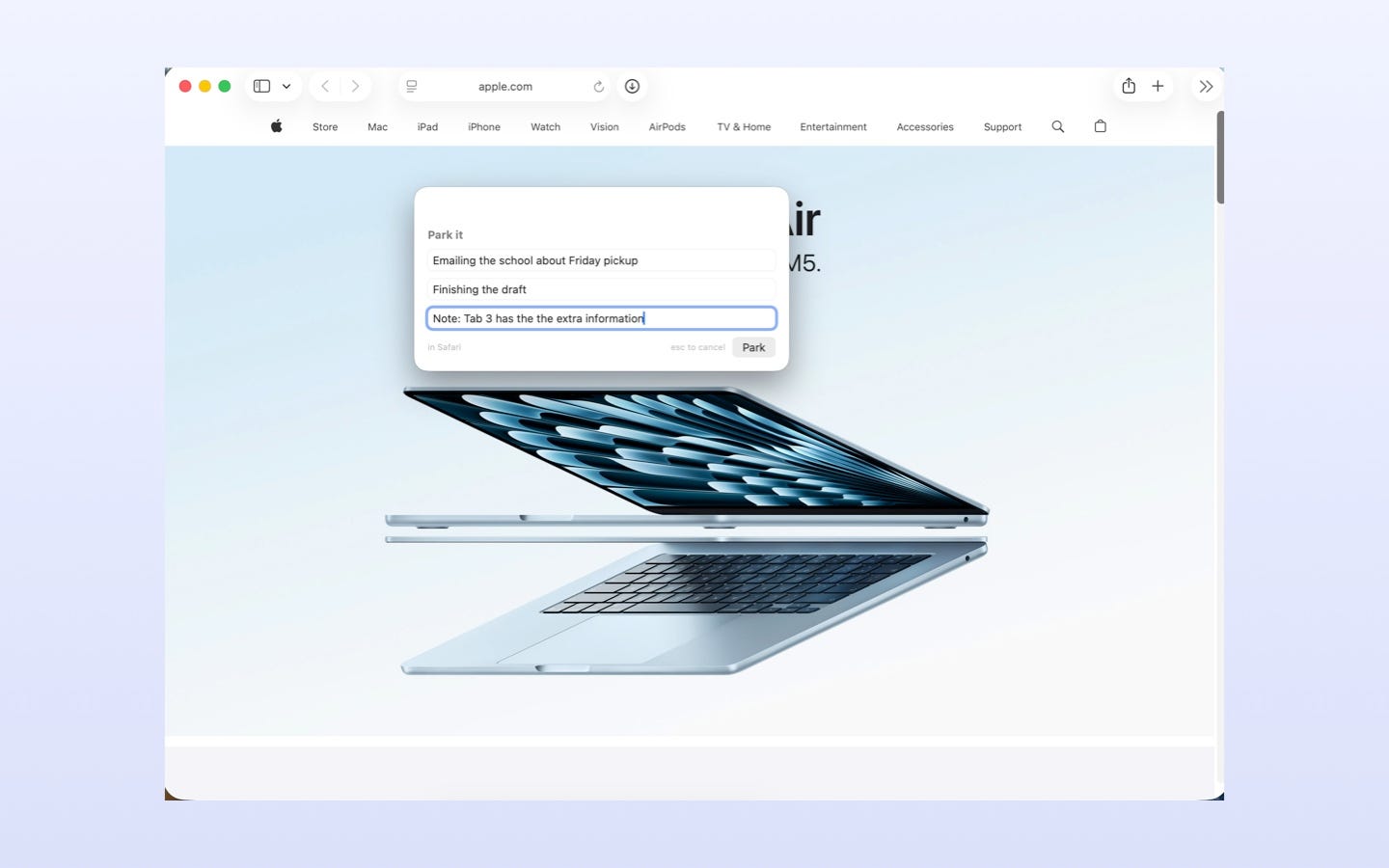
Here’s how it works. The moment you’re interrupted, you hit one key combination. A tiny panel appears, already waiting for your cursor. You type three things:
What you were doing
The very next step, in plain language
Anything else your brain is holding (optional)
Hit Return. Walk away. The whole thing takes under ten seconds, because that’s the actual design constraint: it has to be faster than the interruption itself.
If you get interrupted again before you’re back, you park again. The cards stack, newest on top, so you always resume in the right order.
Back to that Thursday. If I’d had this running, the snack interruption looks like: hit the hotkey, type “writing the MDM draft” / “finish the sentence about interruption cost, next line is about the discipline myth” / nothing else, hit Return, get the snack.
When I sit back down, I click the little tray icon in my menu bar. There’s the card, with the next step in the biggest text on the screen, because that’s the part that actually gets you moving again. I don’t reconstruct anything. I just read it and keep typing.
James Clear puts it plainly in Atomic Habits: “You do not rise to the level of your goals. You fall to the level of your systems.” I didn’t need more willpower to hold a thought through an interruption. I needed a system that didn’t ask me to.
How to park a thought in under 10 seconds
You’ve tried capturing thoughts before. A note on your phone. A scratch file on your desktop. And every time it felt like more work than just hoping you’d remember. Then you didn’t remember.
The problem was friction.
Here’s how to make it stick. 5 steps, each one building on the last.
1. Set your hotkey
Pick one key combination. The moment you’re interrupted, you hit it. A tiny panel appears, already waiting for your cursor. No navigation. No app switching. No “where was that note again” while a four-year-old repeats herself louder.
The hotkey is the whole interface. If it takes more than a second to trigger, it’s already too slow.
2. Park 3 lines
Three things, every time: what you were doing, the very next step in plain language, and anything else your brain is holding (that third line is optional). That’s the whole capture.
The next step is the part that matters most. “Finish the sentence about interruption cost” gets you moving. “Keep writing” doesn’t. Be specific enough that future-you doesn’t have to guess.
3. Walk away
Give the kid the snack. Answer the Slack. Let the dog out. The cards stack automatically, newest on top, so if you get interrupted again before you’re back, you just park again and keep going.
You don’t have to organize anything. You don’t have to remember anything. The stack remembers the order for you.
4. Resume from the menu bar
When you sit back down, click the tray icon. Your most recent card is waiting, with the next step in the biggest text on the screen.
That’s intentional. The next step is what gets you moving again, so it gets the visual priority. You don’t reconstruct anything. You don’t re-read context and hope the thread comes back. You just read one sentence and keep typing.
5. Everything stays on your machine
No account. No cloud. No sign-in. No analytics. No network connection of any kind. It notices which app you were in when you parked, so your card has context, but it never touches your screen, your documents, or anything you typed anywhere else.
When you delete the app, the data is gone. It only ever lived in one folder on your machine.
That’s the whole system. One hotkey. Three lines. Under ten seconds.
Tonight, not this weekend, download it, set your hotkey, and park one real thought the next time someone says your name mid-sentence. That’s the whole test.
It’s called Interrupt Stack. It’s $14.99 this week as part of the launch (regularly $19.99), one-time, no subscription, and it’s live on the Mac App Store now.
Go download it, set your hotkey, and the next time someone says your name mid-sentence, you’ll be back in your flow before they finish their request.
Take care of yourselves,
Matt

P.S. Paid subscribers get access to a growing list of perks: discounts, bonus resources, and the full archive of Mitten Dad Minute issues. You can see everything that’s waiting for you here: https://mittendad.substack.com/perks

What you’ve created is something I needed many years ago. My son is 22 now but your App is highly needed for parents of little people!🩷