

Stop Curating the Moment. Start Touching the Carpet
The internal auditor trades real presence for a mental highlight reel. Three ways to fire it tonight.

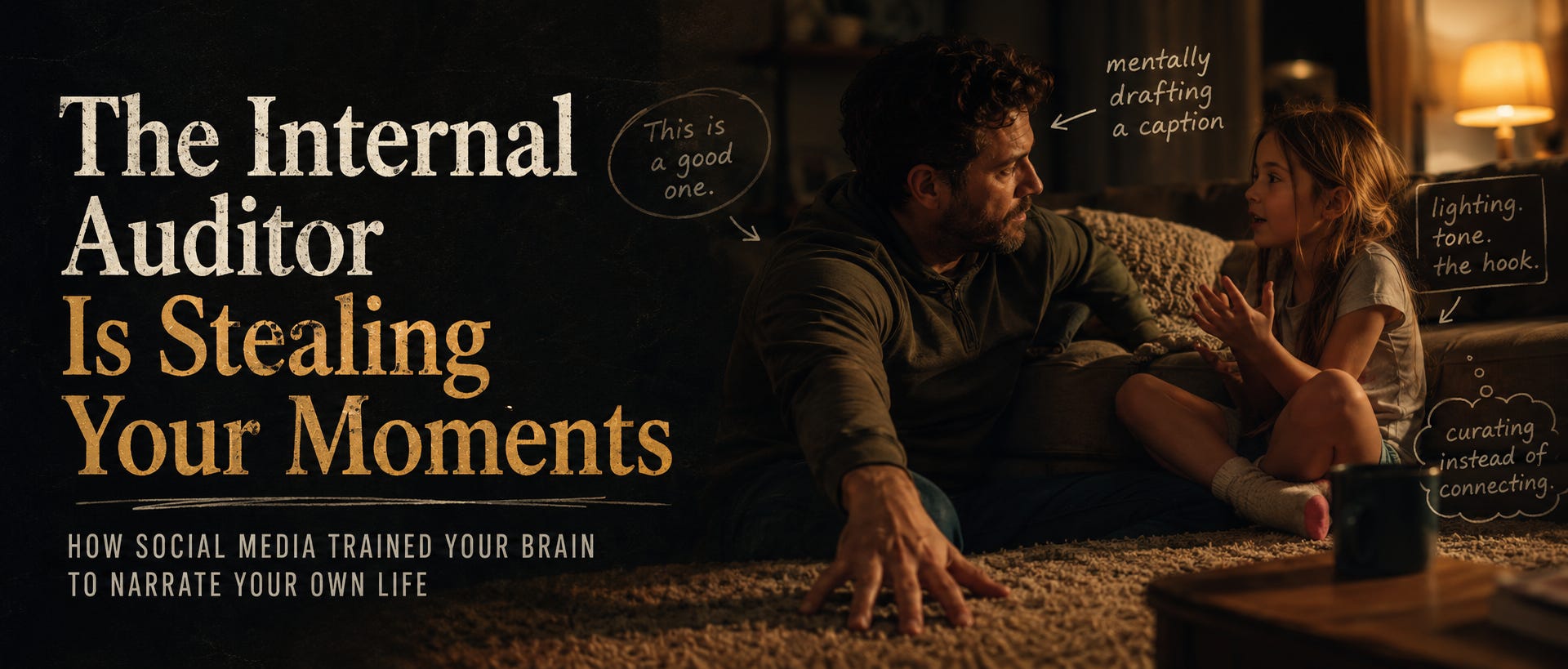
You’re at dinner with someone you love. Or a friend you haven’t seen in months. Or just sitting on the couch next to your partner after a long week, scrolling away.
They’re telling you something. A story about their day. A thing that bothered them. Something funny that happened on the way home.
And part of you is somewhere else entirely. That part is writing.
This is a good one, the voice says. You’ll want to remember this.
You’re mentally drafting a caption.
The phone isn’t even out. But you’re already packaging the moment: the lighting, the way the story unfolded, the detail you’d lead with. Already curating a version of a real conversation for an audience of nobody.
The person you’re with might notice. Or they might not.
But you notice. Because there’s a tiny drop in your stomach when you realize you weren’t actually there for the thing you were already trying to save.
I’ve started calling it the internal auditor.
You probably know the version of this story I’m telling.
It shows up differently depending on who you are. If you’re a parent, it’s your kid mid-sentence (something about a stick they found, or who got sent to the office, or why the blue cup is unacceptable today) while you’re running a focus group on whether this moment is “good enough” to remember, record, or retell.
If you don’t have kids, it still shows up. On a date where you’re already planning how to summarize it. On a walk where half your attention is on drafting the post about how present you’re being (whoops). In a conversation with a friend, where you’re tasting the anecdote while they’re still talking, looking for the hook.
The auditor doesn’t care if you have kids. It cares if you’re the kind of person who treats experience as material.
Note: Consider becoming a paid subscriber today, and get some great perks as listed here (I’m going to continue to add to this), in addition to other goodies! Annual subscribers can get 20% off!
The auditor sounds rational. Helpful, even. “You’ll want to remember this.” “Capture it before it’s gone.” “This is the stuff that matters.”
It’s a thief. And what it steals is bigger than one conversation.
It trades the messy, complete experience (the one where you can smell the carpet and hear the hum of the fridge and notice that the person across from you has a tiny expression you’d somehow never catalogued) for a sterile thumbnail. A two-sentence caption. A mental screenshot with the contrast turned up.
It convinces you that curating the moment is the same as being in it.
That’s a lie. And the bill comes due later than you think.
Naval Ravikant put it bluntly once: money is worth less than life. Life is worth less than attention.
Money you can make back. Time you can’t get back. But attention is the thing that turns time into something worth having. And the auditor is bleeding you out, one Thursday at a time, while the person in front of you is still talking.

How Social Media Trained Your Brain to Narrate Your Own Life
If you’ve caught yourself writing the post in your head while the moment was still happening, pondering “this would make a great IG Reel”, you know the drop in your stomach when you realize you weren’t actually there.
This isn’t for people who are fine with half-listening. It’s not for the person who thinks “uh-huh” counts as presence. It’s for the ones who felt something shift when they caught themselves doing it and couldn’t shake it for the rest of the day.
The thing is, nobody meant for this to happen.
Social media trained us to see every moment as potential content. The language we use in our lives is cute until it becomes a script. Until we’re the ones who can’t stop performing.
There’s a reason this feels so hard to turn off. You’ve been practicing. Every post, every story, every caption you’ve ever written has been training your brain to stand just outside your own life and narrate it.
But here’s what I keep coming back to: my kids don’t audit the moment.
They’re just…in it.
No part of them is wondering if this is content-worthy, or whether they should be somewhere more productive. I watch them and feel a little embarrassed. Because I used to be able to do that.
Before I started creating, I was just in rooms. Present, bored even, but present. The auditor showed up the same way it did for you: one caption at a time, until performing the moment felt normal.
You don’t get a second chance at raising your children, so be present and go hard for them. - @justinlaboy
Why Presence Feels Harder After You Become a Creator
So I tried something.
The next time my daughter started telling me about her day (same time, same couch, a different Thursday), I felt the auditor kick on. This is a good one, it said, right on cue.
And instead of following the thought, I reached down and touched the carpet.
That was it. The whole intervention. My hand is on the floor of our living room, feeling the texture of a rug that needs to be vacuumed, or a foot, scraping the crumbs of half-eaten Cheerios.
It sounds too simple. But physical sensation does something that mental effort can’t. Your brain can’t be in two places when your hand is reporting back from one of them. The carpet was scratchy and warm and real, and suddenly the caption I was drafting 30 seconds ago didn’t seem important anymore.
The hum of the fridge came back. The way she was sitting (one leg tucked under, sock half-off). The whole room, which had been reduced to a backdrop for content, became an actual room again.
That’s the transformation. The room comes back. The person in front of you stops being material and becomes a person again.
At the end of the day, the most overwhelming key to a child’s success is the positive involvement of parents. - Jane D. Hull
I’ve been trying to turn this into something repeatable. Here’s what I reach for when the auditor starts narrating my living room.
Three Ways to Fire the Internal Auditor Tonight
Name the auditor
Touch something in the room
Ask one follow-up question
1. Name the auditor.
When you catch yourself curating (mid-conversation, mid-dinner, on a walk, in the middle of someone else’s story), just say it in your head. “That’s the auditor.”
You don’t have to fight it or shame yourself for it. Just name it. The naming loosens its grip. It turns the voice from an invisible director into something you can see, which means something you can step around.
2. Touch something in the room.
The carpet. The edge of the table. Your own knee. The arm of the chair. Grass, if you’re outside. Your partner’s hand.
What matters is that physical sensation anchors you to the experience instead of the curated version of it. Your brain can’t run a focus group while your hand is reporting that the seat cushion is warm from someone else sitting there.
One parent on Twitter put it even more directly: treat your phone like a landline. Hang it up in one place. When you need to check it, walk over, look, and walk away. The same principle works for the mental phone.
The point is the same: put something physical between you and the audition.
3. Ask one follow-up question.
Not “How was your day?” That’s a reflex.
Ask something specific. Something you don’t already know the answer to.
“What surprised you today?” “What made you feel something you weren’t expecting?” “What moment from this week do you think you’ll remember in 5 years?”
When I started asking better questions, the answers stopped being soundbites and became actual windows. A friend attempted a joke that didn’t land. My daughter is proud of someone for trying anyway. A small moment of vulnerability that someone trusted me enough to share.
That’s the thing I would have missed.
If I’d been writing the script in my head, I would have filed it under “nice conversation” and moved on. But the real thing was sweeter and more complicated than any caption I could have written.
That’s not a core memory.
That’s just a Thursday. That’s just someone on the couch, telling me about their day.
And I was there for all of it.
What to do tonight.
The next time someone starts telling you something (anything), and you feel the urge to curate it, touch something. The carpet, the table, your own knee. Doesn’t matter what.
Then ask them one question you don’t already know the answer to.
Tonight, when the auditor kicks on, touch the carpet before you touch your phone. Just once. Reply and tell me what you noticed that you would have missed.
If this hit home for you, consider taking a moment to hit the heart and restack buttons, as it’s one of the best ways to let Substack know this matters and helps with the discovery of it for others.
Take care of yourselves,
Matt
P.S. Earlier this week, I shipped a tiny Mac app called Interrupt Stack. It gives you a 10-second ritual when something (or someone) breaks your focus. I built it because I kept losing my train of thought between Slack pings and “Dad, can I have a snack?” If your attention gets yanked around all day and you want a small tool that helps you land instead of crashing, you can grab it here.
P.P.S. I use Mem as my external brain. When a random thought, task, or idea shows up while someone is talking, I don’t try to hold onto it. I dump it into Mem and get back to the carpet. Holding something in your head while pretending to listen is just the auditor in a different costume. Use code MITTENDAD for 20% off 3 months of Mem Pro.
P.P.P.S. I wrote parts of this essay using Eden. It helped me pull together the research, organize the argument, and find the structure underneath what started as a rambling note about carpet texture. Try it free here. And if you want to see how I used it for a full creative project, I wrote about that too.